
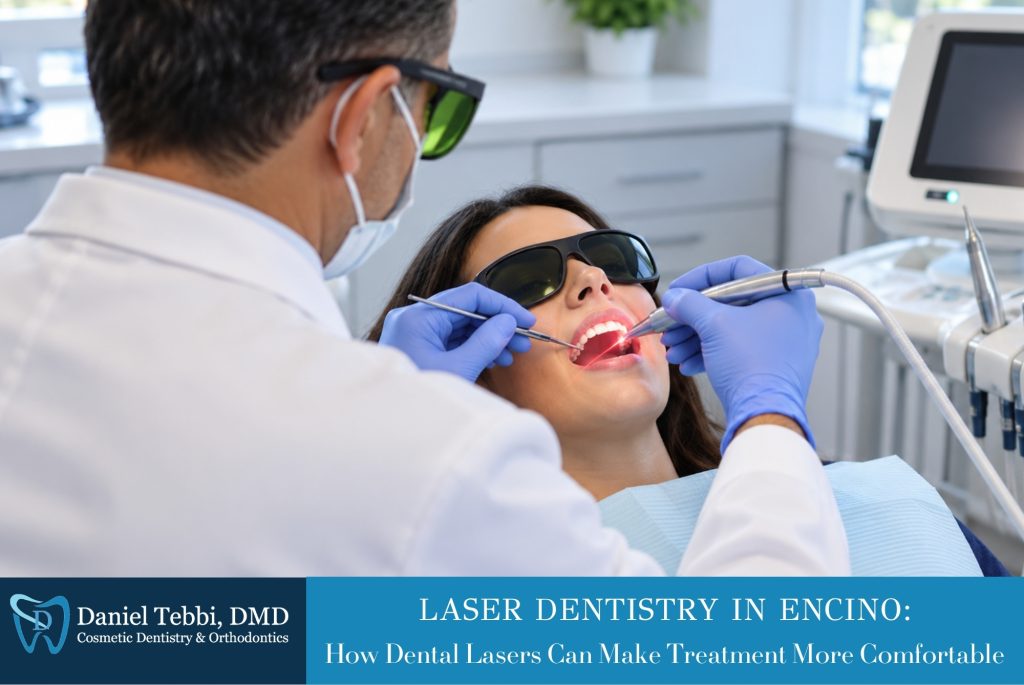
Dental technology continues to change how many oral health conditions are treated. One important advancement is laser dentistry, which allows dentists to use concentrated light energy for selected soft-tissue and periodontal procedures.
Daniel Tebbi, D.M.D. offers laser dentistry in Encino and uses soft-tissue laser technology for multiple periodontal, restorative, and oral soft-tissue applications.
What Is Laser Dentistry?
Dental lasers deliver highly focused light energy that can interact with oral tissues. Different laser systems and wavelengths are designed for different clinical applications.
In appropriate cases, a soft-tissue laser can allow a dentist to precisely remove, reshape, or treat gum and other soft tissue.
What Can Dental Lasers Treat?
According to the practice, laser dentistry may be incorporated into procedures involving periodontal disease, bacterial decontamination, periodontal pocket management, crown lengthening, gingivectomy and gingivoplasty, selected soft-tissue lesions, frenectomy, and other procedures.
The appropriate use of a laser depends on the diagnosis and treatment being performed.
Can Laser Dentistry Be More Comfortable?
One advantage of lasers is precision. A laser can target specific soft tissue while helping control bleeding at the treatment site.
Depending on the procedure, patients may experience less bleeding and swelling than with some conventional surgical techniques. However, lasers do not eliminate the need for anesthesia or traditional dental instruments in every case.
Laser Dentistry and Gum Disease
Periodontal disease develops when bacterial plaque and inflammation affect the tissues supporting the teeth. Treatment depends on disease severity.
Laser therapy may be incorporated into periodontal care for selected patients, but it does not replace fundamentals such as plaque and tartar removal, good home care, appropriate periodontal maintenance, and ongoing professional evaluation.
Are Dental Lasers Safe?
Dental lasers can be used safely when operated by appropriately trained dental professionals using proper protective measures.
Patients and dental team members may wear protective eyewear specifically designed for the wavelength of laser being used.
Is Laser Treatment Right for Everyone?
Not necessarily. Treatment should be based on the condition being treated, the tissues involved, medical history, and clinical findings.
An examination allows Dr. Tebbi to determine whether laser treatment, conventional treatment, or a combination of techniques is most appropriate.
Frequently Asked Questions About Laser Dentistry
Does laser dentistry hurt?
Patient experiences vary. Many laser procedures are designed to minimize tissue trauma, but anesthesia may still be necessary depending on the procedure.
Can lasers treat gum disease?
Lasers can be incorporated into certain periodontal procedures. The overall treatment plan may also include scaling and root planing, periodontal maintenance, improved home care, and other therapies.
Will I still need a dental drill?
Possibly. Not every dental procedure can be completed with a laser. Traditional instruments remain necessary for many treatments.
Can dental lasers reduce bleeding?
Soft-tissue lasers can help coagulate tissue during certain procedures, which may reduce bleeding at the treatment site.
How do I know whether laser dentistry is appropriate for me?
A dental examination is the best starting point. Your dentist can diagnose the problem and explain whether laser therapy offers an advantage for your particular treatment.
Contact Information
Daniel Tebbi, D.M.D.
16661 Ventura Blvd Ste 620
Encino, CA 91436
Phone: (818) 789-2034
Website: bestencinodentist.com
Request an Appointment